How to Find Consumer Newsletters to Sponsor: The Complete D2C Guide
For D2C and ecommerce brands facing rising paid social costs, newsletter sponsorships offer a way to reach engaged consumer audiences without competing in an algorithmic auction. But results depend almost entirely on one thing: finding newsletters whose readers genuinely match your customers. This complete guide covers how to do that, from discovery through testing.
Why Audience Fit Decides Everything
For a consumer brand, a newsletter sponsorship succeeds or fails on a single question: do these readers want what I sell? A well-written ad in a poorly-matched newsletter underperforms a mediocre ad in a well-matched one, consistently.
That makes discovery — finding the right newsletters — the highest-leverage part of the process, more than creative or budget. Get the match right and everything else gets easier. See what are newsletter ads for background on the channel.
Step 1: Describe Your Customer Beyond Demographics
Demographics alone are not enough for newsletter matching. What matters is interests and values — what your customer reads about, cares about, and identifies with.
A brand selling sustainable homewares should think about readers interested in slow living, sustainability, and home design — not just "women 30-45." Write two or three sentences describing your customer's actual interests and mindset. That description drives every step that follows.
Step 2: Translate Interests Into Categories
Newsletters are organized by topic, so translate your customer description into the newsletter categories they read. Sustainable homewares might map to sustainable living, home and interiors, and slow-living lifestyle.
Aim for two to four categories rather than one, since consumers read across several interests. This is the step most brands skip, and it is where a lot of the best-matched newsletters are found — one category over from the obvious one.
Step 3: Surface Candidates Quickly
Manually hunting consumer newsletters across these categories can take days. A newsletter database compresses this into a single session by indexing newsletters by category, including the smaller and mid-sized publications that generic web search buries.
Lettrbase lets D2C and ecommerce brands search by category and surface 50-80+ consumer newsletter leads per search — turning the most time-consuming part of the process into a quick search. See also how to find newsletters in any niche.
Step 4: Qualify on Fit and Engagement
From your pool of candidates, request media kits and evaluate each on:
- Audience description specificity — precise reader descriptions beat vague ones
- Open rate relative to size — engagement matters more than subscriber count
- Editorial tone — would your product feel native here, or out of place?
- Sponsor density — fewer advertisers per issue means more attention on yours
Read a couple of back issues before committing. It is the fastest way to judge whether your brand genuinely belongs there. For a full framework, see how to qualify a newsletter before you sponsor it and newsletter benchmarks worth sponsoring.
Step 5: Prioritize Fit Over Size
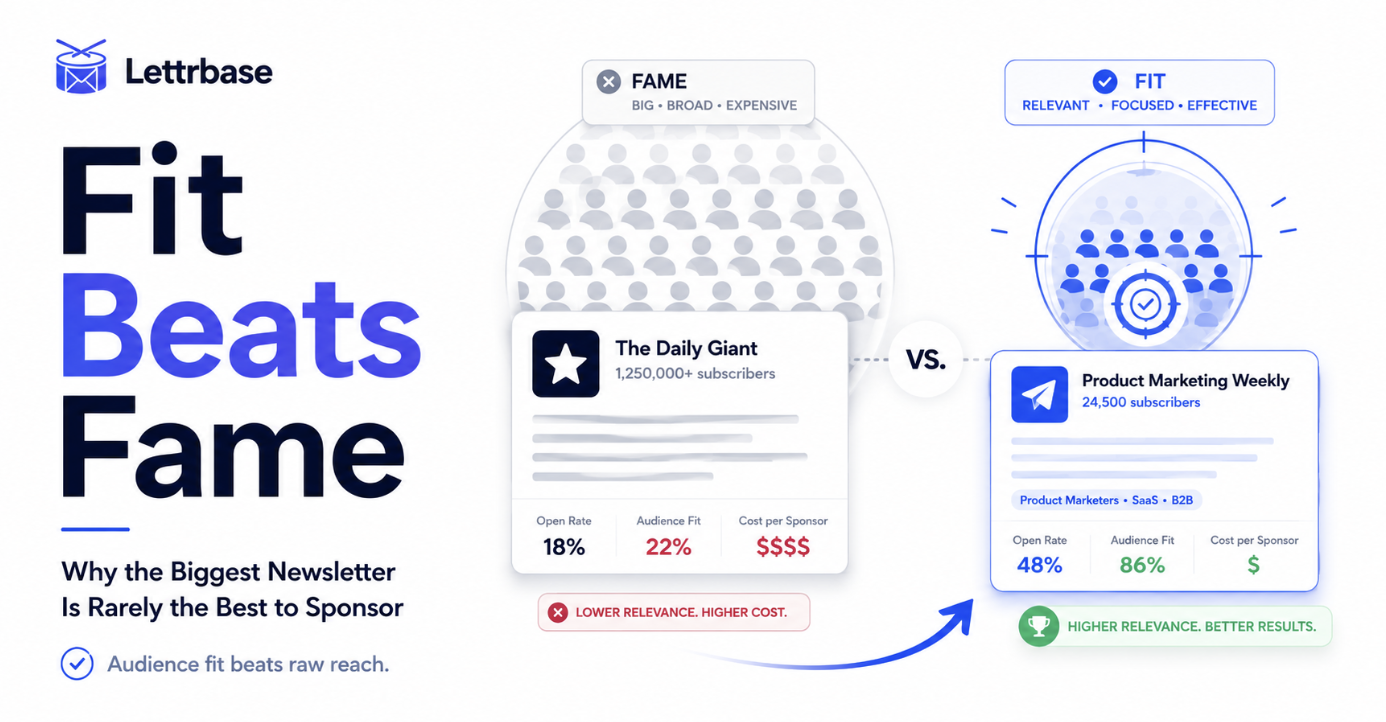
The single most important principle: a smaller newsletter with a precisely-matched, engaged audience will usually outperform a larger newsletter with a broad, loosely-matched one.
A 50,000-subscriber list at a 15% open rate reaches 7,500 people, most of whom are not your buyer. A 5,000-subscriber list at a 45% open rate reaches 2,250 people who are all interested in your niche. The smaller one frequently wins on cost per acquisition. Resist the pull toward the biggest publications — audience precision drives D2C newsletter performance far more than reach.
Step 6: Start Small and Spread
For a first test, spread a modest budget across six to ten smaller and mid-tier newsletters rather than concentrating it in one or two large ones. More data points, less risk, and a clearer read on which categories resonate. See how to test newsletter sponsorships without blowing your budget.
Step 7: Track by Newsletter
Use a unique UTM link and, ideally, a newsletter-specific discount code for each placement. Without per-newsletter tracking, you only learn that "newsletters worked" or "did not work" — rather than which specific ones did, which is the only actionable finding. See how to track newsletter advertising results.
What to Expect From Your First Test
Treat a first campaign as a learning exercise as much as a performance one. Its real value is discovering which newsletters, categories, and audiences respond to your product — knowledge that makes every future campaign sharper. Give it multiple placements per newsletter and judge results across the aggregate, not a single issue. See what to expect from your first D2C newsletter sponsorship.
The Bottom Line
For D2C and ecommerce brands, newsletter sponsorship success comes down to audience fit. Describe your customer by interests, translate that into categories, surface candidates with a database rather than manual search, qualify on fit and engagement, prioritize fit over size, and test across several newsletters with per-newsletter tracking.
Lettrbase is a newsletter database that helps D2C and ecommerce brands find consumer newsletter leads by category — so you can build a shortlist of genuinely matched publications instead of settling for whichever newsletters you already knew.