How to Test Newsletter Sponsorships Without Blowing Your D2C Budget

Many D2C brands hesitate to test newsletter advertising because they assume it requires significant upfront spend to learn anything meaningful. It doesn't. With the right structure, a small budget can generate enough data to know whether the channel is worth scaling — without the risk of a large, poorly-structured test that burns budget and produces inconclusive results.
This post lays out a low-risk framework for testing newsletter sponsorships on a tight D2C budget.
The Mistake That Wastes Test Budgets
The most common way D2C brands waste their newsletter test budget is by spending it all on one or two large, expensive placements. The logic seems reasonable — bigger newsletter, more reach, more potential sales. But it produces fragile data: if those one or two placements underperform (which any single placement can, for reasons unrelated to the channel's overall viability), the brand concludes newsletters don't work and abandons the channel.
A better approach spreads a small budget across more, smaller placements — generating more data points and reducing the risk that a single bad placement skews the entire conclusion.
Step 1: Start With a Small, Defined Budget
A meaningful newsletter test can be run for as little as $1,500-$3,000. The goal of this budget isn't to drive significant sales — it's to learn which types of newsletters and audiences respond to your product. Treat it as research spend, not performance spend.
Step 2: Prioritize Small and Mid-Tier Newsletters
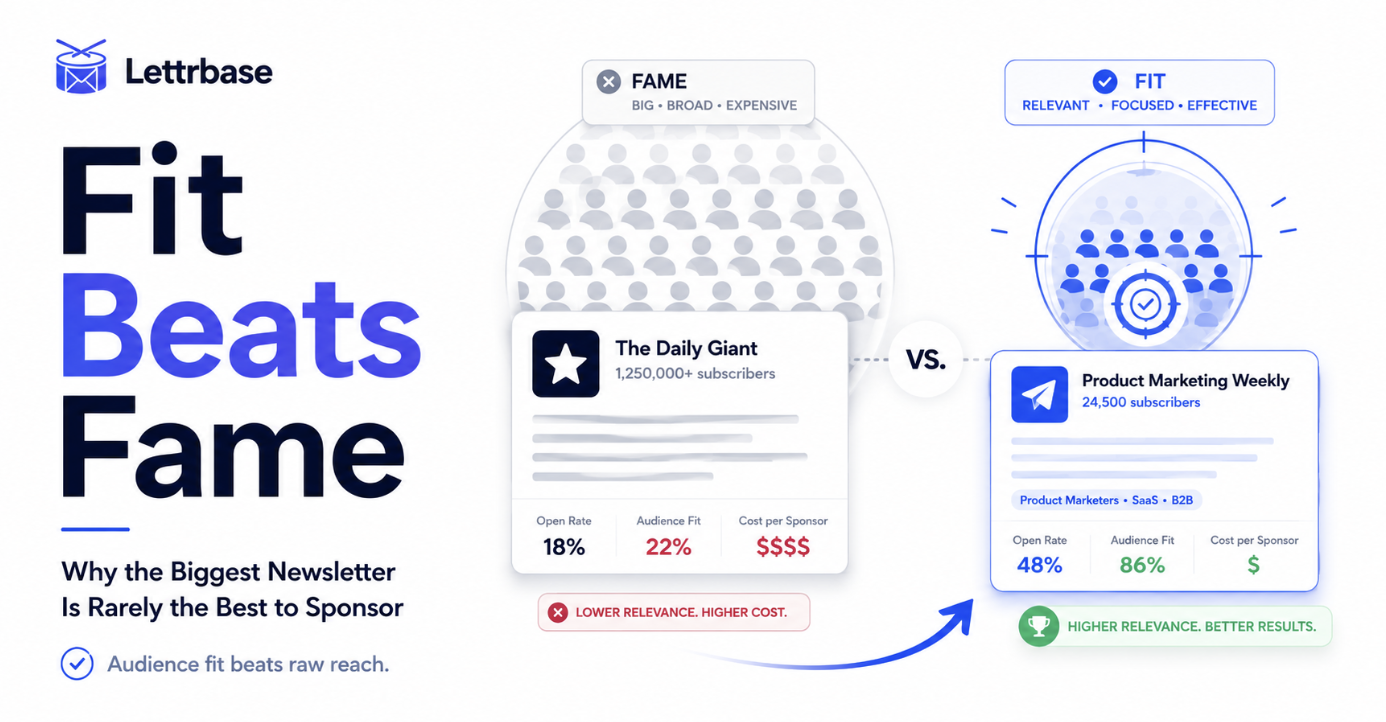
With a limited budget, concentrate on newsletters in the under-15,000-subscriber range, where placements typically cost $50-$400. This lets you test 6-10 different newsletters rather than 1-2 large ones — far more data for the same spend.
Smaller newsletters also tend to have more engaged, more specific audiences, which often means better performance per dollar for D2C products with a defined target customer.
Step 3: Test Across Multiple Categories
Rather than putting your entire test budget into one newsletter category, spread it across 2-3 categories that could plausibly reach your customer. A wellness brand might test wellness, fitness, and healthy-cooking newsletters. This reveals not just whether newsletters work, but which audience angle resonates most — valuable information for scaling later.
Step 4: Use Proper Tracking From Day One
Every placement needs a unique UTM link and a dedicated landing page, ideally with a small newsletter-specific discount code. This lets you measure performance by individual newsletter and by category, so the test produces actionable conclusions rather than a vague sense of whether it "worked."
Without this tracking, even a well-structured test produces unusable data. With it, even a small test produces clear signals.
Step 5: Give Each Newsletter a Fair Shot
Resist the temptation to judge a newsletter on a single placement. If budget allows, give your most promising candidates 2 placements rather than spreading to additional newsletters — a second placement often performs differently than the first, and the average of two is far more reliable than a single data point.
If the budget only allows single placements, treat the results as directional rather than conclusive, and plan a second round of testing for the newsletters that showed early promise.
Step 6: Read the Results in Aggregate and Individually
After the test, analyze the data two ways:
- Individually: Which specific newsletters drove the best cost per acquisition? These become your scaling candidates.
- In aggregate: Did newsletters as a channel come close to your target CAC? Which categories performed best? This tells you whether and how to expand.
Even if no single newsletter was a runaway success, a category that consistently performed near your target CAC is a signal worth pursuing with a larger second round.
Scaling After a Successful Test
If the test identifies 2-3 newsletters performing at or near your target CAC, the scaling path is straightforward: negotiate multi-issue packages with those winners for better rates, increase placement frequency, and use the budget freed up by cutting underperformers to test new newsletters in the best-performing categories.
This turns a small, low-risk test into a repeatable, compounding channel — without ever having risked a large budget on an unproven bet.
It Starts With Finding the Right Newsletters to Test
A low-risk test depends on having enough small and mid-tier newsletter options to spread your budget across. Lettrbase is a newsletter discovery database that lets D2C brands search by category and surface a broad pool of consumer newsletter leads across multiple sizes and niches — giving you the range of options needed to structure a smart, low-risk test.