How a SaaS Growth Team Found 80 Newsletter Leads in One Search
A mid-stage B2B SaaS company wanted to test newsletter sponsorships as a new acquisition channel. The marketing team had identified the strategy as promising — but the research process was the part nobody had time for.
This is a walkthrough of how that team approached newsletter discovery, what they found, and what they did with it once the research was done.
The Starting Point: A Familiar Bottleneck
The growth marketer leading the project had a clear ICP in mind: heads of demand generation and growth at Series A and B SaaS companies. She knew, in theory, that newsletter sponsorships could reach this audience effectively. What she didn't have was a list of actual newsletters to evaluate.
Her initial attempt followed the standard manual process: Google searches for "B2B SaaS newsletter," a handful of names from prior knowledge, and outreach to three or four publications she'd personally subscribed to. After a week, she had five newsletters in a spreadsheet and two media kit responses.
At that pace, building a real shortlist — let alone testing multiple newsletters — would have taken most of a month.
The Shift: Searching by Category Instead of by Name
Rather than continuing to search for newsletters one at a time, she switched approaches and used a newsletter discovery database to search by category instead. A search for "technology" newsletters on Lettrbase returned over 80 leads in a single query. A follow-up search for "business" newsletters added another 75.
This single shift — from searching for specific newsletters to searching by category — changed the scope of what was possible. Instead of five newsletters discovered over a week, she had a research pool of over 150 potential leads in under an hour.
The research step that had consumed a week of part-time effort was compressed into a single afternoon. The bottleneck wasn't the strategy — it was the discovery method.
From Lead List to Shortlist
With a substantial lead pool, the next step was qualification. The team applied a simple filter: did the newsletter's audience description match their ICP statement (heads of growth and demand gen at Series A-B SaaS companies)? From the 150+ leads, roughly 30 newsletters passed this initial screen based on their category and apparent audience focus.
From those 30, the team requested media kits and narrowed further based on open rate, sponsor slot availability, and editorial quality — reading several back issues of each newsletter before making a final decision. This qualification process took about a week, run in parallel with other work, and resulted in a shortlist of 12 newsletters across a mix of sizes.
What the Test Programme Looked Like
The team allocated a 90-day test budget across the 12 shortlisted newsletters, structured in three tiers: 2 larger anchor newsletters for reach, 7 mid-sized niche newsletters for performance, and 3 smaller test placements to evaluate newer publications.
Each newsletter received 2-3 placements over the test period, with UTM-tagged links and a dedicated landing page to track performance by source. This gave the team enough data points per newsletter to draw meaningful conclusions, rather than judging the channel on single-issue results.
What They Learned
By the end of the 90-day test, four of the twelve newsletters had produced consistent, trackable signups at a cost per acquisition competitive with the company's existing paid channels. Three of the four were mid-sized, niche newsletters — not the largest publications in the shortlist.
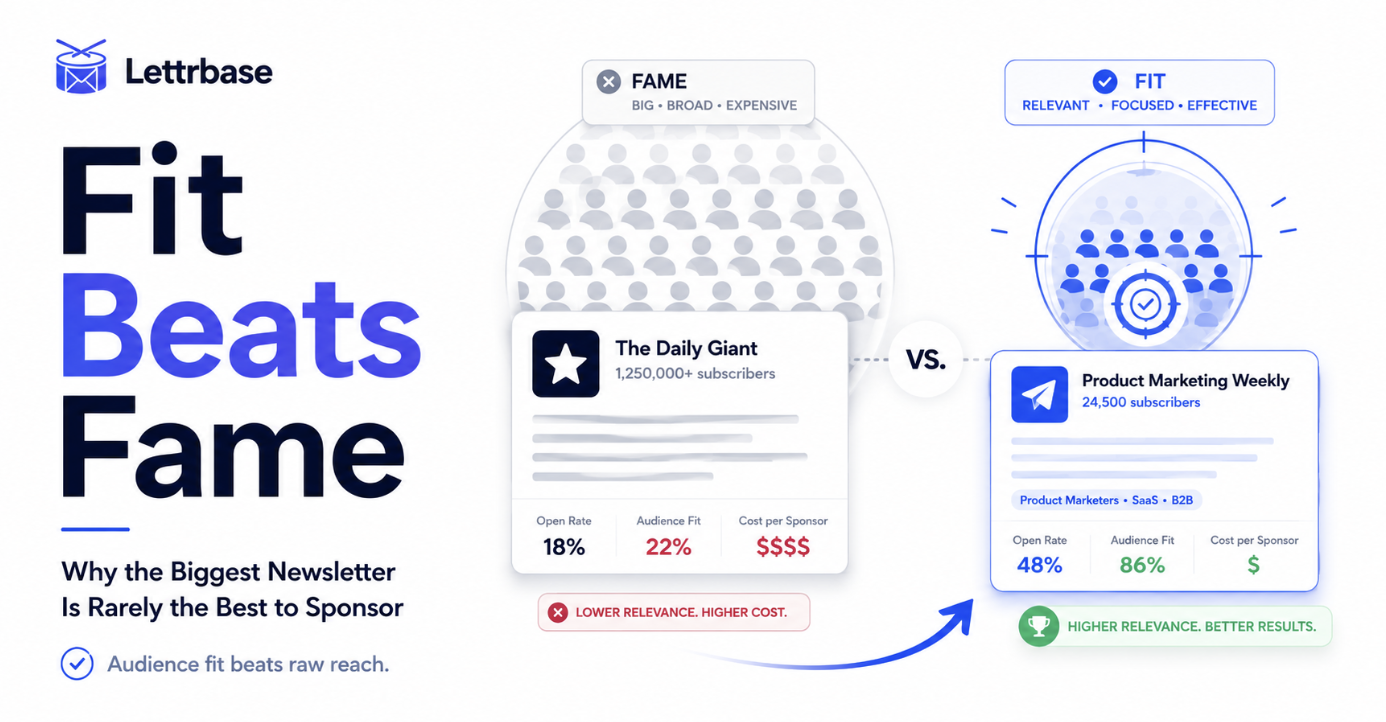
The team's conclusion echoed a pattern common across newsletter advertising: audience specificity mattered more than raw subscriber count. The newsletters with the most precisely defined audiences — even at smaller scale — outperformed broader, larger publications.
The Research Step Made the Difference
What made this test possible within a reasonable timeframe wasn't a different advertising strategy — it was a different research approach. Searching by category instead of by name turned newsletter discovery from a weeks-long manual process into a same-day research session, freeing up the team's time for the qualification and testing work that actually determines performance.
Lettrbase is the newsletter discovery database that made this possible — search by category, surface a library of leads instantly, and spend your time on evaluation and testing instead of hunting for publications one by one.